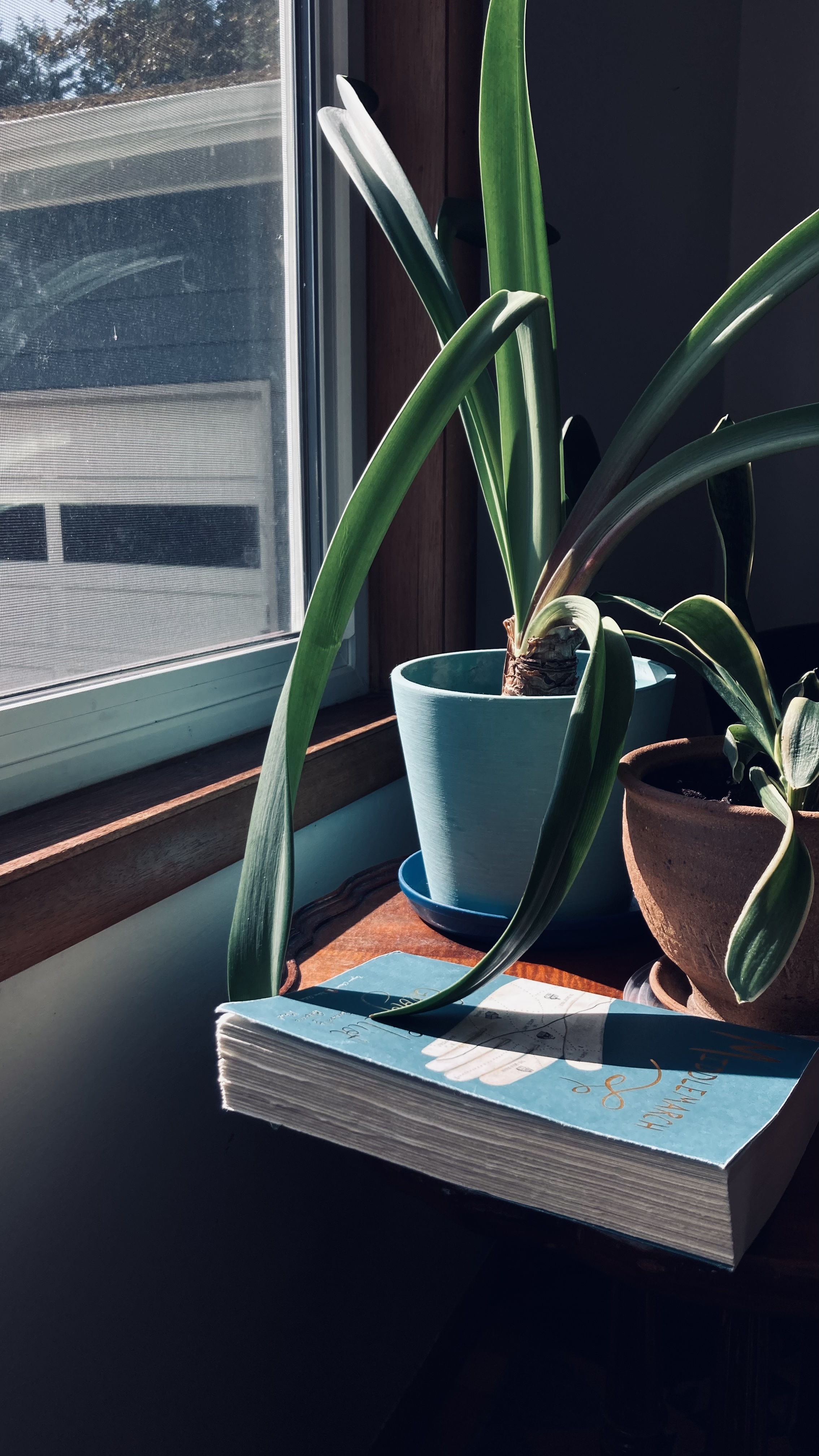
It is a stunning fall day and I’m alone in my house for the first time in 11 years. This is not strictly true but maybe you’ll understand when I say it’s emotionally true. This is the first year all of my children are in school, and I am not. In school. Or taking board exams. Or working outside the home. Instead, I am sitting at a little desk by a big window with George Eliot’s book beside me, feeling the gorgeous sun on my skin and listening to something hum gently somewhere in the house. Maybe it’s the HVAC fan or the freezer in the basement. Whatever it is, it’s a purposeful, quiet sound I never hear because four children in a modestly-sized house are not quiet.
I have not had this kind of quiet in a long time.
I chased quiet for a while. In between things.
Naptime, library storytime, wildfires
Smartphones, diagnoses, road trips
Spray mops, slime kits, Paw Patrol
Big things and little things that wore me down and simultaneously grew my patience, rewrote what I knew about love, and built a new foundation under my faith. A few years ago, I stopped chasing quiet in order to write, and started collecting quiet in my heart, for no reason, to make nothing and please no one. Because I needed the quiet for myself, and because I needed to know what I needed writing for, before I tried it again.
Maybe I also went quiet because of wounding. Writing honestly online brought rejection from a few former friends. Substack became another social media universe of noise and overwhelm. I was tired– I am tired– of the Internet, the age of AI, and trying to figure out where I go with a gift that originally had nothing to do with these things.
That’s a long preamble to a simple, Hi. I’m here.

I’ve been reading Middlemarch with my friend Callie since summer solstice, a midpoint of sorts in the calendar year. It seemed like a good day to launch our boats into this hefty English novel, because it turns to some degree around the questions and realizations of midlife. Scaffolding around the term “midlife” is rickety at best, but something about sending my last baby off to school, and being alone in my house like this, and a number of other recent transitions, makes me want to think out loud about where I find myself.
If mid means a perfect halving, then I hope I’m not there yet; I’d love to live to 86 and beyond. But if mid is more of a zone, the way new landscapes make themselves known by a few different flowers here and there, before the trees and horizon change, then I think I’ve reached terrain where one sort of life is behind me, and a new one is here.
Middlemarch is this kind of terrain: in the English countryside, somewhere between a city and a country town. It’s a middle sort of place, where people are reconciling the life they are living now with the one they’ve lived before, and the dreams they may have had. How do those expectations square up with today? If they’re disappointed or horrified with where they find themselves– and many are– was it that they made the wrong choices, or were the expectations faulty, hastily taken up without fully considering whether they were the right set of expectations to begin with?
In Middlemarch, we meet the young, vibrant Dorothea Brooke, stubbornly insisting on a doomed marriage to the aging, emotionally-dead Casaubon. Both enter into marriage with entirely different goals and expectations, and both are disappointed and ultimately feel trapped and isolated in an unhappy bond. Dorothea is an intensely-feeling idealist whose deepest desire is to somehow contribute to the alleviation of suffering in her community. Her love of God feels indivisible from a commitment to justice, and she feels misunderstood and thwarted in her goals by her wealthy but much-preoccupied scholar husband. She comes to confide in Casaubon’s much younger (and bitterly resented) cousin, the artistic Will Ladislaw, about her plight.
Dorothea insists to Will that she has no longings. But then goes on to qualify,
“I mean, for myself. Except that I should like not to have so much more than my share without doing anything for others. But I have a belief of my own, and it comforts me.”
“What is that?” said Will, rather jealous of the belief.
“That by desiring what is perfectly good, even when we don’t quite know what it is and cannot do what we would, we are part of the Divine power against evil– widening the skirts of light and making the struggle with darkness narrower.”
If I get nothing else from this novel, I think I will spend the rest of my life grateful to have these sentences in my pockets. Narrowing the struggle with darkness and widening the skirts of light. How perfect an affirmation is that for times like these?
Like Dorothea, this is a longing that has been with me a long time. For me, it makes tangible a spiritual uneasiness that I have come to see as a gift: How do I honor the One who gave me life by doing the most I can with what I’ve been given? How can I tip the balance of justice in an unjust world, even if the shift is imperceptible? Maybe at midlife, much moreso than at Dorothea’s age, the realities of how much of a difference we can make become thrown more starkly into relief.
What can I do? Does it matter? How do I know where I’m needed? What if I fail?
Then, too, at midlife we find ourselves much more hemmed in by specific limitations. At 26, I could sleep on a mattress in a friend’s spare room, or live in an off-the-grid trailer while working part-time on a vegetable farm, riding my bike after work to the garden I kept behind my church, where I grew zucchini and cilantro for the food pantry. I had no money and no kids and nothing but time and health and energy. My vision for the good I could do in the world was small and simple, but I could do it.
These days, I struggle daily with what I would like to do for others and what I have the capacity for while caring for four kids, a family, a home. I go through cycles of overcommitting and burning out. I sign up to serve meals downtown and then have to take my child to urgent care or tend to my own health problems. I try to help weekly in the church food pantry but end up overwhelmed, leaving home where my toddler is melting down, my tween is frustrated with homework, and there are phone calls to make to the school district to get a 504 in place for our neurodivergent son.
Life already feels like too much, yet I still feel I am not doing enough. I am not always sure that I’m doing all God wants for my life by raising my kids, trying to grow emotionally and spiritually so I can be good to those I love, and taking time for rest and for joy. Even in these small things, I am often overwhelmed, my heart slips into the wrong place, and I forget to do it all for love of God.
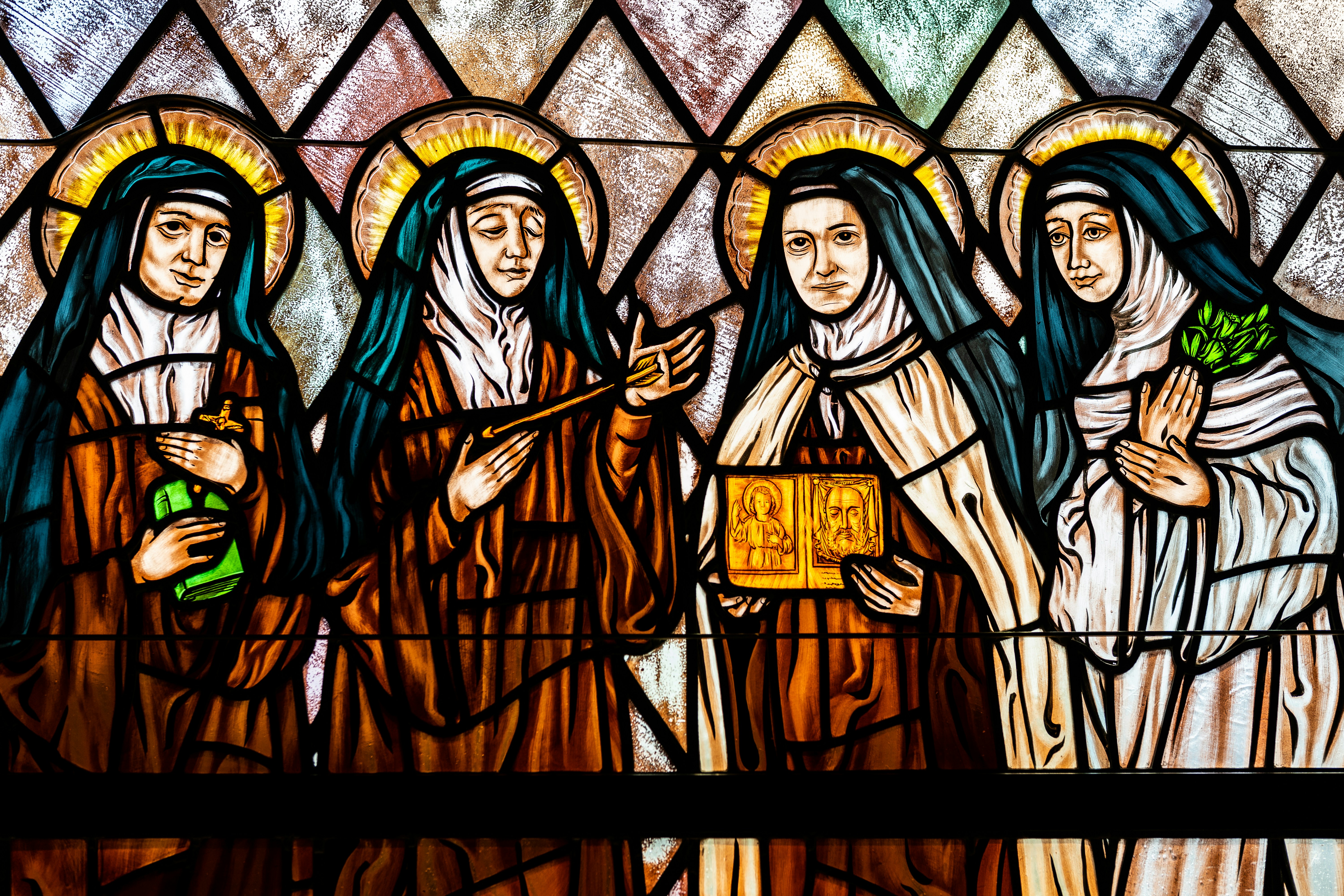
I recently learned about a Spanish nun who had a series of visions of the Lord in the 1920s and 30s. According to her journals, Jesus said to Servant of God Josefa Menendez: “I love you as you are. I know that your frailty will cause you to fall more than once. I know that you will practically never do what you promise me, but your good will and your humble trust with which you come to me after your fall glorifies me so much that my heart gives to you immense graces.”
This is so comforting to me, as it always is when I read accounts of the saints, and see how they grumbled, stumbled, fell, and got up again. Of course they did. They were human just like us. St Therese of Lisieux especially emulates this in her writings on the Little Way.
It reminds me very much of the oft-repeated poem of Thomas Merton’s, read in part here by Fr James Martin, one of my favorite people of all time: “Lord…the fact that I think that I am following your will does not mean that I am actually doing so. But I believe that the desire to please you does in fact please you. And I hope I have that desire in all that I am doing.“
I’m an Enneagram Type 1– the perfectionist or optimizer– but I don’t think I’ve been ready to work on that until now; this is, in fact, characteristic of Enneagram work. It’s perhaps a tool specifically for middles, for midlife. As Richard Rohr writes in The Enneagram: A Christian Perspective:
“By our twenties, our personality type is well-established because it works for us in some strange way. But in the middle of our life we may begin to see the other side of the coin, the dark side of our gift. When we are excessively fixated on our supposed gift it becomes a sin. Maintaining this self-image, this false self, becomes more and more exhausting.”
Maybe midlife is when we finally get to work.
Or as Mark Manson writes in The Subtle Art of Not Giving a Fuck:
“This is what is admirable…The people who just laugh and do what they believe in anyway. Because they know it’s right. They know it’s more important than they are, more important than their own feelings and their own pride and their own ego. They say, ‘Fuck it,’ not to everything in life, but rather to everything unimportant in life. They reserve their fucks for what truly matters.”
At this point in my life, if you’ll pardon the language, I am trying to give fewer fucks. Some of that work is being done for me by virtue of an aging body, raising four kids, there being only 24 hours in a day, and a modest increase in the amount of time I have available to do more than the basics.
But the rest of it is taking active participation and intention: being aware of when I am caring too much about something I don’t actually need to care about. This does not come easily for Type 1s on the Enneagram. Type ones are pretty sure we need to give a fuck about everything, all the time.
I think the invitation of midlife, and the invitation of Christ, in part, is to look our limitations squarely in the eye and give thanks for them, while we do our best (and fail) to rightly order our lives around the One who matters most, who is Love, and who loves us unconditionally.


 This is an article about
 I just started writing short introductions for Image Journal‘s weekly online feature Poetry Friday.


