Writing Log # 3: Taking off

bXoAlw8gT66vBo1wcFoO_IMG_9181

It has been a big month!

The anthology I’ve been editing over the past year is finally finished, printed, and waiting in boxes in my living room for this week’s first mailing session and book launch party. It’s beautiful. I love it so much and I can’t wait to get it into the hands of many, many readers.

I launched my Indiegogo campaign and in a matter of weeks, my friends and family launched ME on the road to New Mexico. I leave next Friday morning for a weekend writing workshop with Tupelo Press, one big step toward finishing by first collection of poems. I’m amazed and so grateful.

And yesterday I found out that I was accepted into this year’s Teaching Artists Studio, run by Young Audiences of Oregon and SW Washington. I’m beyond excited for this series of intensive weekend professional development workshops for practicing artists who teach young people. It’s going to be incredible, and it starts in just a few weeks.

With all of this excitement (and more…), I’ve been sleeping less and thinking a lot about details. Wine cups for the event, mailers for book distribution, renting a mini-van in Albuquerque so I can carpool to the Truchas workshop with other poets. Emails and press releases and even an interview.

In between, I’ve managed a few naps, some hasty notes for poems, and sneaky bits of new reading (Mark Doty’s memoir Firebird, strange and beautiful; Joan Didion’s A Year of Magical Thinking, because I still haven’t read it; Denise Levertov’s Light up the Cave, a favorite.) There’s a sinkful of dirty dishes in the kitchen, and a pile of rebar and pvc pipe in the garden, waiting to be turned back into a hoophouse for our winter bed. The ants are making inroads and the romaine lettuces are shivering, but they’ll have to wait.

I’ve been elbow deep in the pre-conference assigned writing, which is challenging and engaging– and hard to make time for during the week. I just find myself with so little energy left after commuting, teaching, prepping, commuting again, and catching up on the aforementioned details. But I’m trying.

I logged a pretty weak three hours this week. I had plans for some good writing time today, but insomnia last night and a power outage at the grocery store midday had other plans. So here I am, catching up and hoping to park myself at my desk after church tomorrow.

Meanwhile, I keep looking for moments to dip into this well of gratitude, and it brings me energy. I’m thankful for the support I feel all around me, including the community of writers I met in my MFA program. After a year apart from them, I was delighted when one plucky poet wrangled a few of us together for what I hope is a monthly Skype workshop, preceded by an exchange of our current poems in progress. That’s this Wednesday and I’m looking forward to seeing their sweet faces and connecting about our work.

 

Writing Log #2: Drafting

Leaves-page-001Last week was a tough one. I barely pulled myself upright on both feet, showered, and made it to work each day, so my morning writing time went out the window. I made up for it on Saturday, though, by clearing my schedule and sitting down at my desk for the morning and early afternoon. I logged a solid 6 hours in that writing chair.

The bulk of it was revising. I have about six or seven different folders stuffed with drafts in various phases of order and disorder. Every month, I try to get away from the house with my book, my typewriter, and my drafts. I dive back into the mess, picking up where I left off and usually finding some new angle on a piece or (less appetizing) realizing that the poem I thought was finished last month actually needs major work.

Then I take everything back home and make changes to the master document on my computer. I just find that I do more of the actual creative work if I separate myself from the computer, and spend time with the poems themselves.

I keep my current version of the book in a three-ring binder, so that I can easily reorder things when I’ve got a new piece or revisions for an older poem.

This month, I couldn’t get away from home, but I’m happy with what I accomplished– and delighted that I’ll be on a plane to New Mexico in a few weeks, for a real chance to get busy with this book. Thank you SO MUCH for your contributions to my Indiegogo campaign. I’ve booked my tickets and I’m starting to work on the pre-conference exercises, which are substantial.

Here’s a poem in progress, something about regret that I’ve been trying to write. Please leave some feedback.

Grass

Once we fell asleep
in the meadow
during a meteor shower,
wind licking our thoughts so
they knelt like blades.

Another night I lay staring
up from bare ground until
I saw one fall—Hello
and I knew I was going
out like that, and you were
an orange glow in the window
washing dishes, tinning
silver on ceramic and then
there, breaking the dark
like a yolk and saying
should I get a blanket?

Tuesday morning, I passed
a couple asleep
beneath a row of cypress
trees— new, and clear of words
they didn’t mean

and I remembered I told you
No, meaning blanket
meaning you in the grass
with me covered in stars,
but you were already gone.


Writing Log #1

Delicate by ChristineMonday I launched my first ever Indiegogo campaign, to fund my attendance at a weekend writing workshop and finish my first book of poems.

I was floored– absolutely floored– at the response from friends and family in the first few days. Even more than knowing that I am much closer to attending the workshop, I am simply struck by the reality of love as a motivating force. Knowing that you guys are rooting for me and that you believe in me enough to contribute– this is tremendous. It really does make a difference in getting to the desk every day, or at least just propping myself up on one elbow, bleary-eyed at 5 a.m., and reaching for my notebook to scribble something down. Instead of saying, nah, I’ll just sleep a little longer, I get up because I have made a commitment to myself and to all of you to finish this book.

So how did I do this week with writing?

I logged 3 hours and 40 minutes, and it felt good, if a little wobbly.

Beginning intensive work on a project or getting back to a regular writing practice has almost always been awkward for me. The work is either wooden or woozy– it’s like I haven’t quite find the right mix of hot and cold. How much control and how much freedom?

I think what I’ve been most excited about is cultivating creative energy for this book, feeling potential begin to circulate in my fingers, ideas gathering. And I’m hoping that this will also lead to more writing away from my desk, more moments– on the MAX, in class, driving, in the shower– when an idea or a question or a line comes to me.

I’ve also been digging through the desk drawer I keep with lost poems and lines– bits of drafts that never made it or rambling freewrites– and experimenting in crafting new work from them.


Chronicle of Summer Reading

PicMonkey CollageIt was a busy summer of teaching, editing, weddings, overgrown zucchinis, crowded swimming holes, and sleepless nights without air-conditioning. Somehow I got quite a bit of reading time, whether on the MAX to work or on the river bank. Our uninsulated old house was often hotter than it was outdoors, so we found ourselves escaping to the somewhat cooler air near the river.

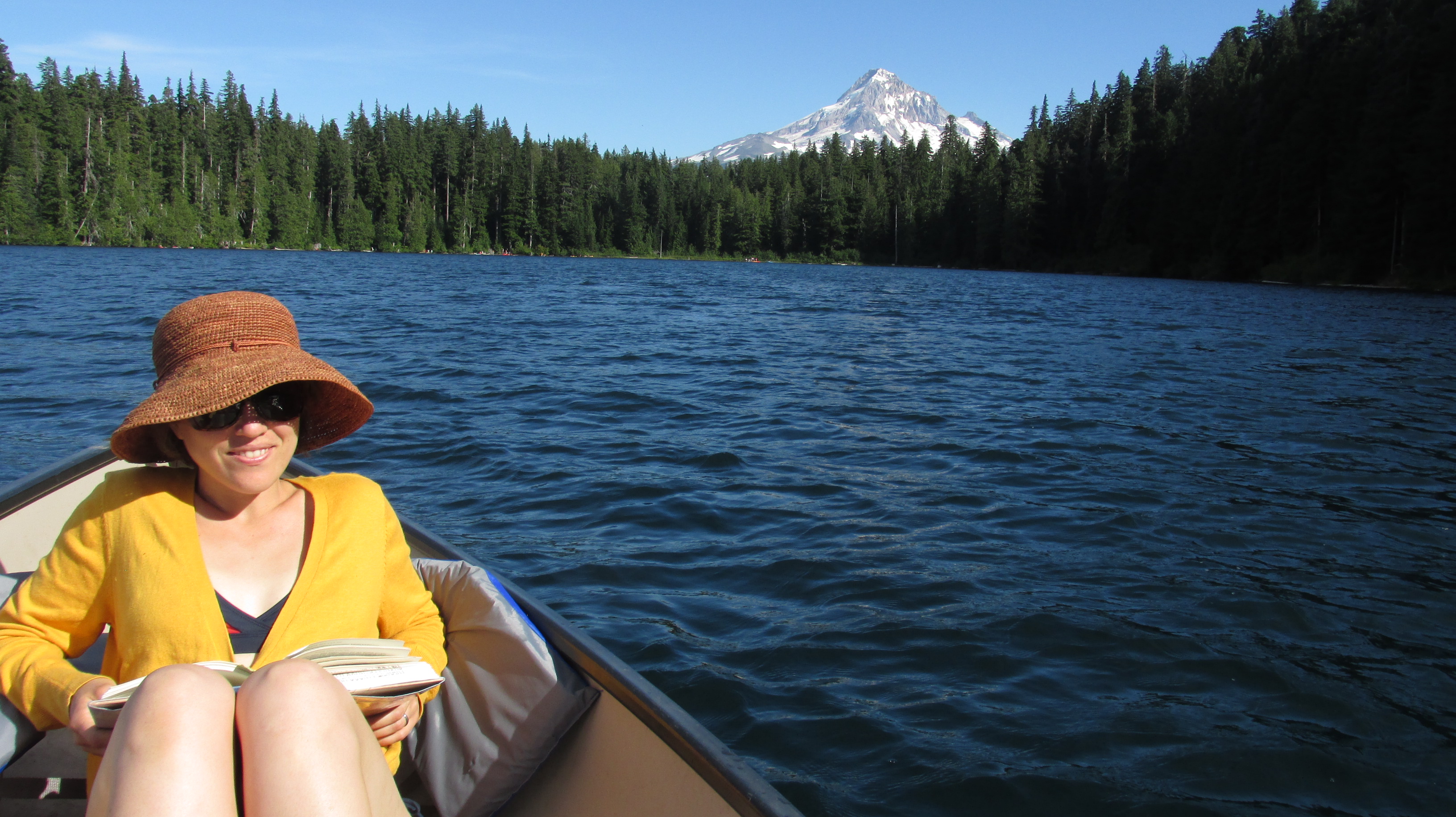
IMG_3853I also confess to reading Half the Sky, (Nicolas Kristof & Sheryl WuDunn’s 2009 survey on the status of women in developing countries) in a canoe.

I really could not put it down. It’s a brilliant argument for the elevation of women worldwide as the human rights issue of our time. It highlights the many strides women and their allies have already made toward reducing maternal mortality, female genital cutting, trafficking, and HIV, and increasing women’s opportunities in education and employment. Well-crafted and personal, the book focuses on specific women in Vietnam, Cambodia, India, Congo, and elsewhere, putting real human faces and stories of hope to otherwise cold and dismal statistics.

I closed the book feeling inspired to learn more and do more for women not only for women around the world, but right here in my own community. It’s interesting to note that in 2014, the maternal mortality rate actually rose in the United States, equaling that of developing countries like Afghanistan. Research suggests that this is due to the fact that a huge percentage of American women enter pregnancy without health insurance, and without access to health care. T.R. Reid, author of The Healing of America, writes: “Thousands of times every month in the U.S.A., women show up at an emergency room nine months pregnant, seven cm. dilated, and they’ve never had a pre-natal visit. Those are the women and babies we lose after childbirth.”

I was so impressed with Half the Sky that I picked up Kristof & WuDunn’s previous book, Thunder from The East: A Portrait of Rising Asia (Knopf 2000), and then Peter Hessler’s phenomenal Oracle Bones: A Journey Through Time in China, which also proved impossible to leave behind on camping trips. It is a wonderfully meandering and dynamic look at China at the first of the 21st century, when Hessler was a news correspondent in Beijing. Similar to Kristof & Wudunn, Hessler approaches a gigantic topic through the perspectives of the particular individuals that topic affects. Hessler weaves ancient Chinese history, linguistics, politics, and economics through his engaging narrative about his own experience and that of his friends. As an English teacher, I’m excited to pick up his previous book, River Town, about his 1996 Peace Corps term teaching English in rural China.

I attempted to read Paulo Freire’s Pedagogy of the Oppressed, because of an interview with artist Daniela Molnar, and because of my interest in developing my consciousness as a teacher in a global work environment. I got about halfway through before I admitted defeat. Sometimes it’s just not the right time for a book– maybe too soon or too late. In my case, I think it was too soon. I need more experience under my belt, or perhaps a primer for some of the dense theories Freire gets into. At the time, I was also looking for more immediate insight into classroom psychology, which I found in Frank Smith’s little treatise on industrial education, The Book of Learning and Forgetting. A fellow teacher recommended it and I whipped through it, stunned by the remnants, in language itself, of the legacy of militarism in the history of modern education. It’s a fascinating read.

Second Person Singular was one of those spontaneous choices made mid-aisle in the library. The grammar teacher in me was drawn to the title first. Translated from the original Hebrew, it’s something of a mystery novel set in modern-day Jerusalem and told from the perspective of an Arab Israeli. It tells the story of two men– one a wealthy lawyer, the other a directionless photographer– who are strangers to each other and yet share the same confusing search for identity in a land where that search is rife with politics and peril.

Earlier in the summer, there was Burqas, Baseball, and Apple Pie: Being Muslim in America, a passionate look at what it means for one American family to embrace their Muslim identity post-9/11. I found it thought-provoking and engaging, though I also thought it lost steam toward the end, when it began to repeat many of the previous chapters’ points. Idliby’s previous book, The Faith Club, has been on my reading list for a long time, and I hope to pick it up later this fall.


we are portland

Among the many things I love about my adopted hometown of Portland (including great public transit and bike routes, community acupuncture, gardens, and beautiful summers), I love the constant overlap of art with shared public space.

The city is full of commissioned sculpture and art installations. Seems like even the tiny corner coffee shop has a rotating exhibit from local visual artists– and a packed waiting list. There’s poetry on the bus and dangling from the trees. There’s practice Shakespeare in the park.

Lately, I’ve been appreciating a series of beautiful photographs at the parks & rec community center down the street. I’m especially interested in it because it’s a project funded by RACC, the same grants organization that has helped make Winged possible:

Check it out!

http://mystoryworkshops.org/View-Programs/71/

We are Portland is a youth-run mobile portrait studio that captures the faces and stories of a changing Portland. These portraits were taken at free Family Portrait Days hosted by My Story’s youth photographers. At these festive neighborhood events, new conceptions of community are formed, and as the portraits are broadly shared, Portland youth focus the lens of public discourse on the places they call home.


on fear and middles and writing

When I was younger, I did my writing on the edges, in early morning and early evening. On the porch step outside my house.  At the top of a trail under an oak tree. My time was largely unclaimed, and I read and wrote with greater abandon. There were fewer anxious thoughts clamoring for my attention, penning in the pastureland my mind needed to ruminate and wander and pause.

What happens when you can’t wait for unclaimed hours?

Lately, I am writing in the middle of things. In the middle of the summer. In the middle of a long to-do list. In the middle of a messy house. In the middle of working on Winged. In the middle of full-time teaching. In the middle of anxiety. In the middle of an endless middle of grief.

Prayer happens like this, too. I read bits of Matthew and Mark on my MAX ride downtown. I close my eyes and pray silently, beside the Thai woman on her cellphone and the big man snoring across the aisle. This week I’m reading passages from Barbara Brown Taylor’s book of sermons, God in Pain. She writes:  “God is stronger than death. Way past where we can see how it works, God is able to take our weakness, our fear, our trembling, and turn it into fullness of life.”

I am focusing on this, in the middle of painful questions about my own fear and sadness. What if I never have a child? I am trying to focus on God’s strength, not my own weariness, when I feel the weight of others’ sadness. For drought and women walking miles for water. For my Japanese student’s friends hit by typhoon Neoguri. For the 80 children who died on that shot down plane. For my friend grieving the loss of a dynamic father-in-law. For the single women in my life, and for the apprehensive mothers-to-be and the weary mothers of young children.

Way past where we can see. I imagine the fullness of the ocean and the mystery of horizon. I speak my fears into that unfolding wideness. I speak my sorrow there. I tell everything I want. I try to look back on this place with God’s eyes, from a place where this is all understood.

Summer 2014 show:tell Workshop

Hey Marylhurst campers!

I’m so glad to be writing with you at show:tell 2014. Here are those links I mentioned in class, for further explorations. May you get lost in the kinship between poems and poets, may link lead on to link and especially on to more of your own poems.

1, 2, 3 Make a Poem workshop

Day 1: More practice for getting words on the page

Read Sylvia Plath’s “Tulips” and circle all of her metaphors and similes. Create metaphor “templates,” then write lines that use the same kind of metaphor for each image. Use one or two of the resulting lines to lead you into a poem.

Get inspired at Hazel & Wren

Day 2: More practice for re-vision

Try rewriting your poem in a different form, such as a villanelle, sestina, or ghazal.

Try this nonce form, the  “semi-glosa,” invented by poet Barbara Crooker. Then invent your own form!

Day 3: How do you know when a poem is finished?

The drafts of Sylvia Plath’s poem “Stings”

The drafts of Elizabeth Bishop’s poem “One Art”

Draft, a really cool lit journal that’s all about first, second, third (etc) drafts


Tattoo & Identity workshop

This workshop on tattoo, writing, and identity was inspired by metal/enamel artist Martha Banyas’ concept of “invisible tattoos” and her short video “The Mysterious Lives of Makers.” In her metal sculptures and paintings, Banyas uses botanical imagery in tattoos on human figures.

We’ve all had experiences that have ‘marked’ us, either visibly or invisibly. Where do these experiences live in our bodies? How do they shape our identities? How can we carry them in our writing and visual art?

These are big questions, and we try a lot of different exercises in this workshop. Here are additional resources and ways to use some of the passageways we explore:

A Thousand Words, an essay about writing from photographs, The New Yorker

self portraits, body image: photography

Shelley Jackson’s skin quilt, a collective tattooed poem

a video about her project

personality quizzes as fodder for poems

The tattooed poets project

Tattoo Highway lit journal

Try Jeanne Murray Walker’s Tulips Exercise

When I was in graduate school, I had the pleasure of working with poet Jeanne Murray Walker. She gave us an assignment for working with metaphor that I found profoundly helpful. It involves reading and observing metaphor in Sylvia Plath’s poem “Tulips,” which you can read here.  

Here are Jeanne’s instructions:

“Okay, here we go.  This is to show you how to go through a poem to create metaphor templates that you can use to generate your own metaphors.  I’m looking at Plath’s “Tulips.”

The first metaphor is “The tulips are too excitable.”   So you might formulate the template like  this.   The X (the given term) is described by an adjective which attributes to it the characteristics of a Y (a human trait).

For the exercise you would write a bunch of metaphors with that format.

Examples:  The sun seems too anxious to rise in the morning.   Why is the watch so eager to race ahead?   The turtle seems oddly philosophical.

The second metaphor in “Tulips” is “Look at how white everything is, how quiet, how snowed in.”   Actually, that’s a series of normal adjectives that leads, in the end, to a metaphor:   “how snowed in”.

The template for this metaphor might be this:   The X (everything in this hospital room) is described by a verb (“snowed in”) which gives it the characteristics of Y (ie whiteness, quietness, emergency, etc.).

For the exercise you would write a bunch of metaphors with that format.

Examples:   How the sun got hemmed in by the gossiping of the big stars.    How unremarkable the chair is, how undistinguished, how—well—belittled by its surroundings.

You go on doing that kind of work through the whole poem.  “Tulips” is built out of metaphors.  To work through it  might take you two weeks.  But it will be two weeks well spent.

Does this give you the idea?   I’m inventing the examples as I go along here, so they’re probably not very good.  But you will do better than this when you do the exercises in your journal.

I made up this metaphor exercise for myself a long time ago and it has been most useful to me when I could follow the format of the original metaphor as exactly as possible.  But all my reading in semantics suggests that metaphor is a slippery and wily animal.  Don’t use that as an excuse to get discouraged.  Just do as well as you can.  Any practice, even if you’re not quite accurate, will help you.  Accuracy is not the ultimate goal.  Try to make good metaphors rather than ones that won’t be useful to you in a poem.   And the ultimate point is not just to gain metaphors you might use, but above all to get a mind nimble for metaphor. Practice in your journals.   And be well.”

Claudia Emerson: Second Bearing, 1919

This is the most recent poem to make me catch my breath, it’s so real. Part of it is that it is a story recounted and recounted, and yet never worn out. Something in that line “I have asked him to tell it.”

Part of it is this idea of a second bearing, beyond expectation, an almost supernatural hope. There’s a peach tree in my own life like this, 60 years old and counting, nearly hollowed by lightning– and still bearing fruit. There’s a poem I’ve tried to write for many years about this tree.

There’s the strange innocence and resilience of the tree. The doom inside of sweetness, mortality. It seems to tell the story of the world– fallen humanity, our poor stewardship of the earth– and there’s also something human about the peach itself: sweetness and death, mixed. It’s the strangest poem.


Second Bearing, 1919
      for my father

by Claudia Emerson

I have asked him to tell it– how
he heard the curing barn took hours

to burn, the logs thick, accustomed
to heat– how, even when it was clear all

was lost, the barn and the tobacco
fields within it, they threw water

instead on the nearby peach tree,
intent on saving something, sure,

though, the heat had killed it, the bark
charred black. But in late fall, the tree

broke into bloom, perhaps having
misunderstood the fire to be

some brief, backward winter. Blossoms
whitened, opened. Peaches appeared

against the season– an answer,
an argument. Word carried. People

claimed the fruit was sweeter for being
out of time. They rode miles to see it.

He remembers by grandfather
saying, his mouth full, this is

a sign, and the one my father
was given to eat– the down the same,

soft as any other, inside
the color of cream, juice clear

as water, but wait, wait; he holds
his cupped hand up as though for me

to see again there is no seed,
to pit to come to– that it is

infertile, and endless somehow.

-from Late Wife, LSU Press, 2005

Try Writing a Semi-Glosa

Try writing a semi-glosa like Barbara Crooker’s poem, “A Woman is her Mother.” Crooker is the author, most recently, of Gold. Find out more about her work here. The semi-glosa is a “nonce” (or invented) form. You’ll need 4 short lines from favorite poems, stories, or songs.

I asked Barbara Crooker how she wrote the poem and this is what she replied. Thank you, Barbara!

“The glosa is a 15th c. Spanish form most commonly seen in English by Canadian poet P. K. Page.  It uses a 4 line stanza from another poet. Each line appears at the end of a ten line stanza (4 stanzas to the poem).  Lines 6, 9, and 10 are supposed to rhyme.  \

So I was really messing around with the form in this one; first, I’m not using a 4 line stanza, but rather, 4 lines from 4 different writers, 4 different poems.  And none of them end the line, nor do I follow the stanza length or rhyme pattern.  Instead, I really “nonce it up,” creating my own pattern.

I’m doing something more like a pantoum, where line 2 of the first stanza becomes line 1 of the second; line 3 of the 1st stanza becomes line 2 of the second, line 4 in the 1st becomes line 3 in the second, etc.  It’s loose, but I wanted the lines to be interwoven.  I’m also using a muted rhyme scheme:  other/air weather; other/everywhere/here; flowers/for us, branch/flesh; back/talk; forward/everywhere, telephone/alone.  So, it’s both formal, and “not,” in that I’m doing something pattern-like, without actually following a pattern exactly, whether a “received form” or one I’ve made up. . . .