Poem Response on Vox Poetica

Here’s a poem I wrote in response to a photo prompt on Vox Poetica, a photo called Alberta Bound by photographer Michael Lee Johnson.

Mind

Stopped by the gate, you pace the place old
wheels have smoothed, tracks so worn

that’s all you see, never mind the fact
they cross over, go on. You believe

in the gate, though your lips shape
other words. Your hands trace the rubbed

wood, paint peeled—listen, you may as well
leave it here. There’s a way out that’s everywhere—

see how the sky goes around and through? Despite
the signs, forgiveness is the usual procedure: an inch

per century pushing up through plates.
The pace isn’t what’s important here. Out

in the estuary the same light grows, seeds
ripen and shake: little fists opening.

I love the tagline for Vox Poetica: “It’s just poetry. It won’t bite.”

I wrote this poem as part of a 30 day poetry challenge I’ve undertaken this August with a friend and fellow poet, and it’s helping me reaffirm that creativity is there in abundance. I don’t have to ration it or fear there won’t be enough. There is plenty there, and plenty of places and people to share it with.

Try writing a poem to a photo prompt from Vox Poetica, Rattle, or the 20 day poem challenge coming up at Ekphrastic Review.

Writing About Climate Change

Here’s a letter I wrote for Dear Earth With Love, a collaborative community chronicle of personal stories about climate change.

My dear friend Jo created this project. I encourage you to write your own letter to the earth, responding to your personal experience with climate change. It could be a letter, poem, story, song, or spoken word piece. It could be a video of a dance or performance; a painting, collage, or sculpture. Whatever medium suits you best, use it and make something– then submit your work.

Dear Earth With Love holds rolling submissions, with a deadline posted every few months.  The next deadline is August 31, 2016.

Read the beginning of my essay here:

Continue reading “Writing About Climate Change”

On Kristin George Bagdanov’s poem “More Strange” at Image Journal

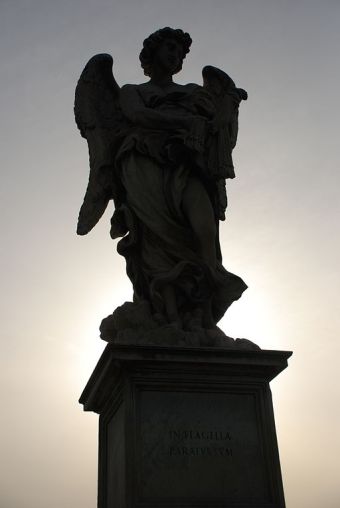
Angel_StatueI just started writing short introductions for Image Journal‘s weekly online feature Poetry Friday.

I love these assignments because they introduce me to new work and new poets, they get me engaged with a journal I love, and they get me thinking– not just about my craft but about my faith.

Especially the poem I recently read and wrote about.

Kristin George Bagdanov’s poem “More Strange” is a compact powerhouse of emotion and complexity. I’ve been thinking about it a lot these past few weeks, moving through some heavy sadness over the brokenness of our world, while simultaneously beginning to wean my 14-month-old. I’ve been feeling weighed down by the violence in the news and grappling with my vulnerability, wanting to protect my child from what I have so little control over. It’s easy to forget God’s sovereignty and providence. It’s all too easy to imagine that grief and pain have the last word.

So this poem has helped, and I’m so grateful when poems help. To me, this too feels like a small sign of God’s living presence– that art heals, that humans can be conduits through which healing can flow. It makes me grateful that I write, that God planted the seeds of an abiding interest in poetry when I was very young. (Thanks, Mom and Dad!)

Bagdanov’s poem is about the most intense grief I can fathom– Mary’s loss of her son– which becomes so much more than human grief, through the mystery of God’s saving grace.

Read Kristin George Bagdanov’s poem at Image Journal here.

Image: By MarcusObal (Own work), via Wikimedia Commons

Janet McCabe Poetry Prize


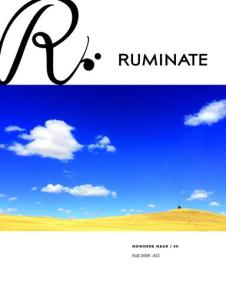
RUM_40_Cover_large

In late June, I learned that my poem “Yellow” won the 2016 Janet McCabe Poetry Prize at Ruminate Magazine. The poem will be published in the September 2016 issue.

Ruminate is one of my favorite publications, and its arrival in my mailbox is one of the small but great pleasures in my life.

It’s beautiful. It’s print. It still comes in the mail. And it’s quarterly, which means several months of anticipation between issues– a novelty in an age when it seems we hardly have to wait to read anything anymore.

I love how each issue takes shape around themes in a life of faith that sometimes go under-explored. I love the visual art it has brought into my life. Though my sister is a talented visual artist, and I always feel enriched on a different level when I make space for it in my life, I confess that I just don’t make that space on my own. So the magazine is a good reminder to make the time.

Continue reading “Janet McCabe Poetry Prize”

Why I Write

When I was eight or nine, my favorite book was How I Came To Be A Writer, by Phyllis Reynolds Naylor. I was fascinated by her story about being my age and writing, and how she managed to make her life as a working writer whose books I loved. This is a “spill” I did two summers ago, just before I gave a talk about “the writer’s desk” at show:tell, a summer camp for teen writers and artists. In it, I tried to answer some questions about why I write, how I write, and what success means to me as a writer.

I’ve written since I was very young. Before I could write, I would tell my parents stories and they would write them down for me, or make cassette recordings. Did they do this because stories spilled from me and it was a way to focus my young energy? I don’t know. I have a story called A Walk in the Woods, which I must have told my dad at age 4 or 5, and which he typed up so I could paste it (backward) into an old calendar and draw the illustrations. (It’s a funny mix of the plot for Cinderella and Hansel and Gretel, with a few horses thrown in and a cameo by my mom, eating a cheese sandwich with alfalfa sprouts. I think I hated alfalfa sprouts at the time and was working it out through story.)

When I began writing for myself, I would ask my parents for Mead spiral notebooks in bright colors from the drugstore, and fill them with poems. I liked to find a corner of the yard or the front stoop, away from the family bustle, usually at a quiet time of the day like just before or after dinner. Sometimes I wonder if the need for solitude and introspection came first, and writing simply became the means to facilitate that communion of self and bigger world.

My time on the porch was meditative, though I didn’t know anything about formal meditation. I sat and felt. I watched the light sink behind our suburban hill, lighting up the scrawny trees and washing the windowless sides of the stucco split-levels. There was some seed of fear planted in me, and a seed of tenderness and sweetness. I intuited that the world of adulthood that lay before me meant broken dreams. I was afraid of this, and I didn’t understand. So I sat on the stoop and tried to tune into this sadness and sweetness.  I loved the light, the birds, the flowers, even though everything in my neighborhood was pretty ordinary and repetitive.

I wrote it down, poem after poem about sunsets, clouds, trees, sky. For most of my childhood and adolescence, I wrote rhyming poems. I followed rhyme schemes and syllabic patterns without thinking much about it, just adopting whatever I picked up from songs and the little poetry I read at that point (Shel Silverstein, Robert Frost, Robert Louis Stevenson, Emily Dickinson).

Poem-making can be like braiding a rope and then climbing it, then continuing to braid as you go. The strange and mysterious part is how it bears your weight. You use it to bear your own weight. You are somehow held up even when you haven’t finished it yet. I write because making shape, form, sound, texture in language makes me feel supported and held in a world that can often feel unfocused, scattered, chaotic, confusing.

Growing up I filled notebooks with poems, occasionally revising them, sometimes making little books of the ones I especially liked. I didn’t share them with others at all. I wrote stories, kept journals, and read and read and read.

I think all of that early practice seeped into me and still shapes what I write, even though I mostly write in free verse, a loose kind of blank verse, or nonce forms—forms I make up as I go, and often deviate from as the poem dictates its own agenda. I think my attraction to rhyme and meter tuned my ear for opportunities to rhyme and make sound links, but I’m not often interested in adhering to a form in the finished draft. Sometimes I use form as a way to climb into a subject or a line. I’ll play with sonnets, haiku, villanelles, sestinas. Sometimes I’ll copy a favorite poem’s form, or write between the lines of a favorite poem. Sometimes, rarely, an exercise leads to a final draft that’s close to the original form assigned. More often, it’s a springboard to get my tongue loosened again.

I can be perfectionistic, and get temporarily obsessed by the time-card approach to process. How many hours should I spend at the desk per day? What time of day? So many writers insist on the same number of hours at the same hour, as a way to train the muse to meet you, to make a date with inspiration. I’ve courted this off and on during my life as a poet so far.

I don’t know what my definition of success is right now. I feel like it always changes. When I was younger, I assumed I would publish several books before I hit 30. Everyone said it would be difficult to make a living as a poet, but I mostly tuned them out and figured they just didn’t know I was destined for greatness. I would show them. I think there’s part of me that secretly still believes that (maybe everyone does?).

What I hold most fiercely to, and what hasn’t changed, is that writing is first and foremost a form of meditation for me. Especially when it comes to drafting poems. The best times are like a kind of self-hypnosis. Mary Oliver has written that she has come to understand that her job is just to pay attention. This is why I started writing poems and still write them. To pay attention. It becomes increasingly difficult to do.

“Writing is an act of attention. You are being conditioned all the time toward distraction and acceleration and away from contemplation. Fight it.” -Carolyn Forche
Writing Log # 3: Taking off

bXoAlw8gT66vBo1wcFoO_IMG_9181

It has been a big month!

The anthology I’ve been editing over the past year is finally finished, printed, and waiting in boxes in my living room for this week’s first mailing session and book launch party. It’s beautiful. I love it so much and I can’t wait to get it into the hands of many, many readers.

I launched my Indiegogo campaign and in a matter of weeks, my friends and family launched ME on the road to New Mexico. I leave next Friday morning for a weekend writing workshop with Tupelo Press, one big step toward finishing by first collection of poems. I’m amazed and so grateful.

And yesterday I found out that I was accepted into this year’s Teaching Artists Studio, run by Young Audiences of Oregon and SW Washington. I’m beyond excited for this series of intensive weekend professional development workshops for practicing artists who teach young people. It’s going to be incredible, and it starts in just a few weeks.

With all of this excitement (and more…), I’ve been sleeping less and thinking a lot about details. Wine cups for the event, mailers for book distribution, renting a mini-van in Albuquerque so I can carpool to the Truchas workshop with other poets. Emails and press releases and even an interview.

In between, I’ve managed a few naps, some hasty notes for poems, and sneaky bits of new reading (Mark Doty’s memoir Firebird, strange and beautiful; Joan Didion’s A Year of Magical Thinking, because I still haven’t read it; Denise Levertov’s Light up the Cave, a favorite.) There’s a sinkful of dirty dishes in the kitchen, and a pile of rebar and pvc pipe in the garden, waiting to be turned back into a hoophouse for our winter bed. The ants are making inroads and the romaine lettuces are shivering, but they’ll have to wait.

I’ve been elbow deep in the pre-conference assigned writing, which is challenging and engaging– and hard to make time for during the week. I just find myself with so little energy left after commuting, teaching, prepping, commuting again, and catching up on the aforementioned details. But I’m trying.

I logged a pretty weak three hours this week. I had plans for some good writing time today, but insomnia last night and a power outage at the grocery store midday had other plans. So here I am, catching up and hoping to park myself at my desk after church tomorrow.

Meanwhile, I keep looking for moments to dip into this well of gratitude, and it brings me energy. I’m thankful for the support I feel all around me, including the community of writers I met in my MFA program. After a year apart from them, I was delighted when one plucky poet wrangled a few of us together for what I hope is a monthly Skype workshop, preceded by an exchange of our current poems in progress. That’s this Wednesday and I’m looking forward to seeing their sweet faces and connecting about our work.


Writing Log #2: Drafting

Leaves-page-001Last week was a tough one. I barely pulled myself upright on both feet, showered, and made it to work each day, so my morning writing time went out the window. I made up for it on Saturday, though, by clearing my schedule and sitting down at my desk for the morning and early afternoon. I logged a solid 6 hours in that writing chair.

The bulk of it was revising. I have about six or seven different folders stuffed with drafts in various phases of order and disorder. Every month, I try to get away from the house with my book, my typewriter, and my drafts. I dive back into the mess, picking up where I left off and usually finding some new angle on a piece or (less appetizing) realizing that the poem I thought was finished last month actually needs major work.

Then I take everything back home and make changes to the master document on my computer. I just find that I do more of the actual creative work if I separate myself from the computer, and spend time with the poems themselves.

I keep my current version of the book in a three-ring binder, so that I can easily reorder things when I’ve got a new piece or revisions for an older poem.

This month, I couldn’t get away from home, but I’m happy with what I accomplished– and delighted that I’ll be on a plane to New Mexico in a few weeks, for a real chance to get busy with this book. Thank you SO MUCH for your contributions to my Indiegogo campaign. I’ve booked my tickets and I’m starting to work on the pre-conference exercises, which are substantial.

Here’s a poem in progress, something about regret that I’ve been trying to write. Please leave some feedback.

Grass

Once we fell asleep
in the meadow
during a meteor shower,
wind licking our thoughts so
they knelt like blades.

Another night I lay staring
up from bare ground until
I saw one fall—Hello
and I knew I was going
out like that, and you were
an orange glow in the window
washing dishes, tinning
silver on ceramic and then
there, breaking the dark
like a yolk and saying
should I get a blanket?

Tuesday morning, I passed
a couple asleep
beneath a row of cypress
trees— new, and clear of words
they didn’t mean

and I remembered I told you
No, meaning blanket
meaning you in the grass
with me covered in stars,
but you were already gone.


Writing Log #1

Delicate by ChristineMonday I launched my first ever Indiegogo campaign, to fund my attendance at a weekend writing workshop and finish my first book of poems.

I was floored– absolutely floored– at the response from friends and family in the first few days. Even more than knowing that I am much closer to attending the workshop, I am simply struck by the reality of love as a motivating force. Knowing that you guys are rooting for me and that you believe in me enough to contribute– this is tremendous. It really does make a difference in getting to the desk every day, or at least just propping myself up on one elbow, bleary-eyed at 5 a.m., and reaching for my notebook to scribble something down. Instead of saying, nah, I’ll just sleep a little longer, I get up because I have made a commitment to myself and to all of you to finish this book.

So how did I do this week with writing?

I logged 3 hours and 40 minutes, and it felt good, if a little wobbly.

Beginning intensive work on a project or getting back to a regular writing practice has almost always been awkward for me. The work is either wooden or woozy– it’s like I haven’t quite find the right mix of hot and cold. How much control and how much freedom?

I think what I’ve been most excited about is cultivating creative energy for this book, feeling potential begin to circulate in my fingers, ideas gathering. And I’m hoping that this will also lead to more writing away from my desk, more moments– on the MAX, in class, driving, in the shower– when an idea or a question or a line comes to me.

I’ve also been digging through the desk drawer I keep with lost poems and lines– bits of drafts that never made it or rambling freewrites– and experimenting in crafting new work from them.


on fear and middles and writing

When I was younger, I did my writing on the edges, in early morning and early evening. On the porch step outside my house.  At the top of a trail under an oak tree. My time was largely unclaimed, and I read and wrote with greater abandon. There were fewer anxious thoughts clamoring for my attention, penning in the pastureland my mind needed to ruminate and wander and pause.

What happens when you can’t wait for unclaimed hours?

Lately, I am writing in the middle of things. In the middle of the summer. In the middle of a long to-do list. In the middle of a messy house. In the middle of working on Winged. In the middle of full-time teaching. In the middle of anxiety. In the middle of an endless middle of grief.

Prayer happens like this, too. I read bits of Matthew and Mark on my MAX ride downtown. I close my eyes and pray silently, beside the Thai woman on her cellphone and the big man snoring across the aisle. This week I’m reading passages from Barbara Brown Taylor’s book of sermons, God in Pain. She writes:  “God is stronger than death. Way past where we can see how it works, God is able to take our weakness, our fear, our trembling, and turn it into fullness of life.”

I am focusing on this, in the middle of painful questions about my own fear and sadness. What if I never have a child? I am trying to focus on God’s strength, not my own weariness, when I feel the weight of others’ sadness. For drought and women walking miles for water. For my Japanese student’s friends hit by typhoon Neoguri. For the 80 children who died on that shot down plane. For my friend grieving the loss of a dynamic father-in-law. For the single women in my life, and for the apprehensive mothers-to-be and the weary mothers of young children.

Way past where we can see. I imagine the fullness of the ocean and the mystery of horizon. I speak my fears into that unfolding wideness. I speak my sorrow there. I tell everything I want. I try to look back on this place with God’s eyes, from a place where this is all understood.

piled up braids

KLBraids

It has been one year since I graduated from the MFA program at Seattle Pacific University. I’m remembering waking up early to write before class, at a table beneath a big window in my upstairs room. I’m remembering the snow that surprised us toward the end of the week, hushing everything under a thick white blanket.  I’m remembering the winter we spent hauling all 1,000+ pages of Sigrid Undset’s trilogy around with us. Set in medieval Norway, Kristin Lavransdatter is a darkly beautiful epic, built on the inner lives of a knot of characters whose flaws bind them painfully to each other. A few of us loved the book, including me.

The last week of the residency, Rachel and I both showed up for breakfast wearing “Kristin braids,” hair piled up and pinned so the wind wouldn’t knock it loose. I have short hair again, but at the residency it was long. This style used to be my remedy for melancholy– waking up to a gray day, after fitful sleep or a late-night deadline. Piling my hair on the top of my head in braids, I felt suddenly taller, fancier. Even in jeans, even under an umbrella.

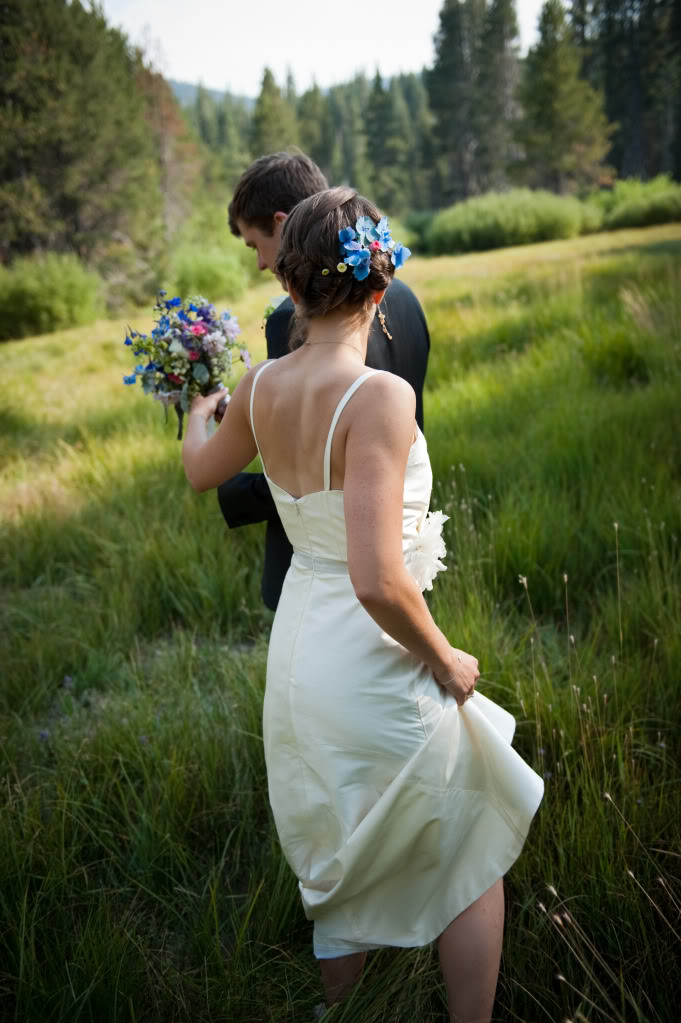
When I married, my hair wasn’t quite to my shoulders, but with enough pins and flowers, who could tell?

wedding-9136